
For years, the global energy transition has been narrated as a linear story. Set ambitious targets, deploy renewable energy, reduce emissions, and move steadily toward net zero. It is a compelling storyline—simple, structured, and reassuring. But reality is far more complicated. Recent geopolitical developments, particularly in the Middle East, have once again exposed a fundamental truth: energy systems do not follow scripts. They respond to shocks, pressures, and trade-offs that often disrupt even the most carefully designed climate pathways. Conflicts and instability in energy-producing regions have triggered volatility in oil and gas markets, supply disruptions, rising energy prices, and renewed dependence on fossil fuels in several economies.
We have seen countries temporarily return to coal, delay phase-out commitments, or recalibrate timelines—not because they lack climate ambition, but because energy systems are deeply interdependent and vulnerable to external shocks. This is not a failure of intent; it is system behavior. Climate governance, therefore, cannot be understood as a linear progression. It is shaped by geopolitics, market dynamics, infrastructure constraints, societal needs, and institutional capacities. The idea of a smooth, predictable transition assumes stable supply chains, adequate financing, coordinated policy action, and aligned global priorities. But in reality, supply chains are fragile, finance is uneven, policies are fragmented, and national priorities diverge. The result is a system where progress is often non-linear—accelerated in some sectors, stalled in others, and occasionally reversed under pressure. Against this backdrop of global uncertainty, India presents an interesting and somewhat counterintuitive case. At a time when many countries are recalibrating their climate pathways, India has chosen to strengthen its commitments.
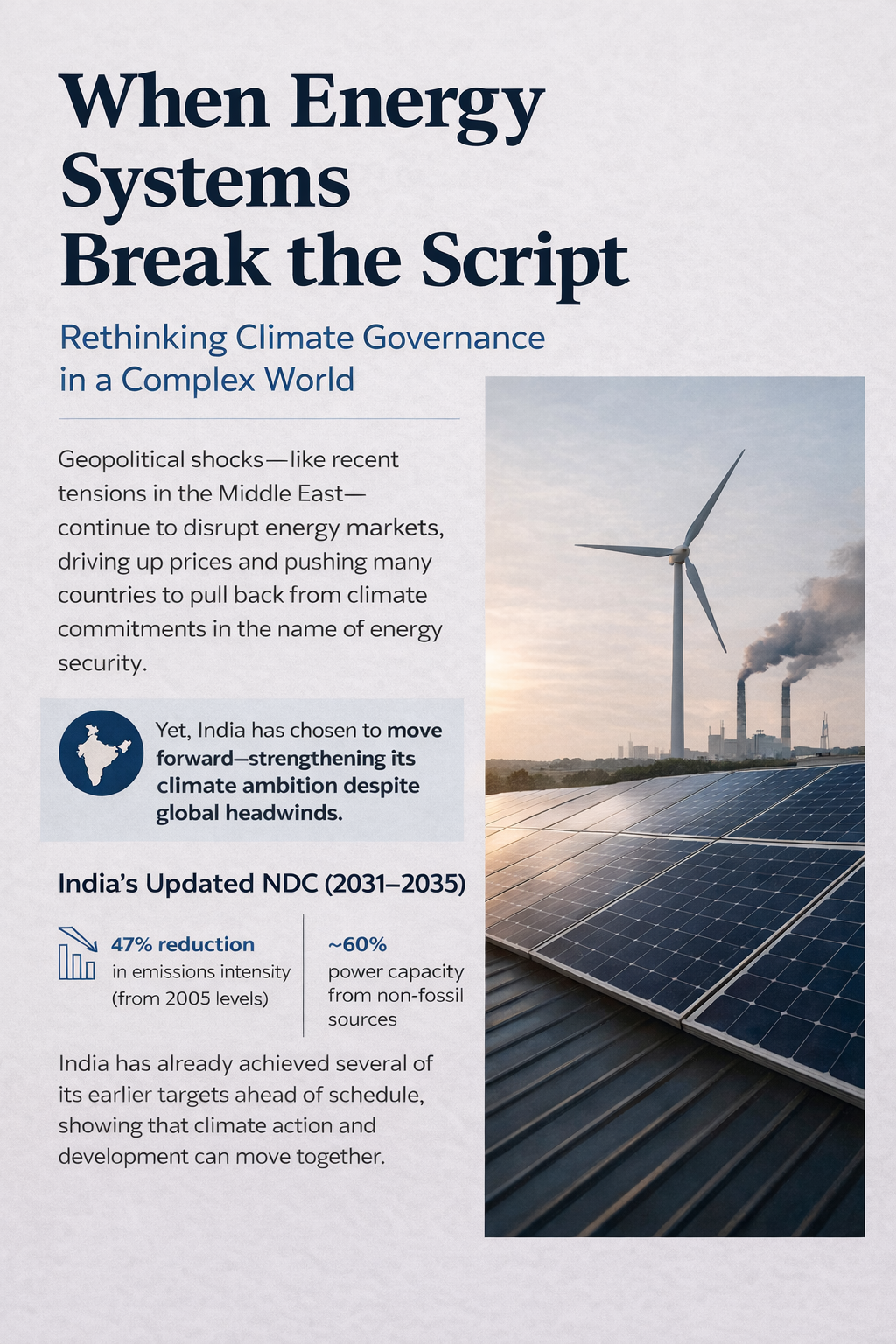
The recently approved Nationally Determined Contributions for 2031–2035 include a 47 percent reduction in emissions intensity of GDP by 2035 from 2005 levels and around 60 percent cumulative installed power capacity from non-fossil sources. These are not incremental adjustments; they represent a scaled-up ambition aligned with India’s long-term vision of achieving net-zero emissions by 2070. What makes this particularly significant is not just the ambition itself, but the context in which it is being articulated. India is not operating in isolation. It faces rapidly growing energy demand, development imperatives, infrastructure constraints, and the same global uncertainties affecting other nations. Yet, it has chosen to move forward rather than retreat.
Even more importantly, this ambition is backed by performance. India has already achieved several of its earlier climate targets ahead of schedule, including significant progress in renewable energy deployment and increasing the share of non-fossil sources in installed capacity. This track record signals that India’s climate strategy is not symbolic—it is operational, adaptive, and grounded in implementation. India’s evolving climate commitments illustrate a critical point: climate ambition and development priorities do not have to be mutually exclusive.
However, aligning them requires careful balancing. It requires long-term strategic thinking, adaptive governance frameworks, institutional coordination, and sustained investment. India’s approach reflects an attempt to navigate multiple, often competing objectives—ensuring energy access for a growing population, maintaining economic growth, strengthening energy security, and advancing climate goals. This balancing act is inherently complex and involves trade-offs between affordability and sustainability, short-term pressures and long-term goals, and domestic priorities and global expectations. The key lesson from both global disruptions and India’s response is clear: energy transition cannot be governed through linear thinking. Instead, it requires a systems perspective—one that recognizes feedback loops between policy, markets, and society, acknowledges delays and unintended consequences, and understands interactions across sectors and scales.
A policy decision in one domain can trigger market responses that reshape investment flows; technological deployment can create new infrastructure demands; climate impacts themselves can alter energy demand patterns; and geopolitical events can disrupt supply chains and pricing structures. In such a system, outcomes do not follow a straight path; they emerge from complex interactions. This has important implications for governance. If energy transition is a complex adaptive system, then governance must evolve accordingly. It must move beyond siloed approaches and integrate climate, energy, and development planning. It must build institutional flexibility, strengthen resilience to shocks, and ensure that transitions remain socially inclusive. It must also acknowledge uncertainty—not as a weakness, but as a defining feature of the system.
The goal is not to eliminate complexity, but to govern through it. Perhaps it is time to move away from the comforting but unrealistic narrative of a smooth, linear transition. Instead, we need a narrative that reflects reality—messy, dynamic, interconnected, and often unpredictable. In this narrative, progress is uneven, setbacks are part of the process, and resilience becomes as important as ambition. India’s evolving climate commitments, especially in the current global context, offer an example of how such a transition might be navigated—not perfectly, but pragmatically. In the end, the energy transition is not just about changing energy sources; it is about transforming systems. And systems, by their very nature, are complex.
The real challenge, therefore, is not whether we can design perfect pathways, but whether we can build governance frameworks capable of adapting to change, absorbing shocks, and aligning diverse priorities. Because ultimately, transition success will depend not only on ambition, but on our ability to manage complexity.