
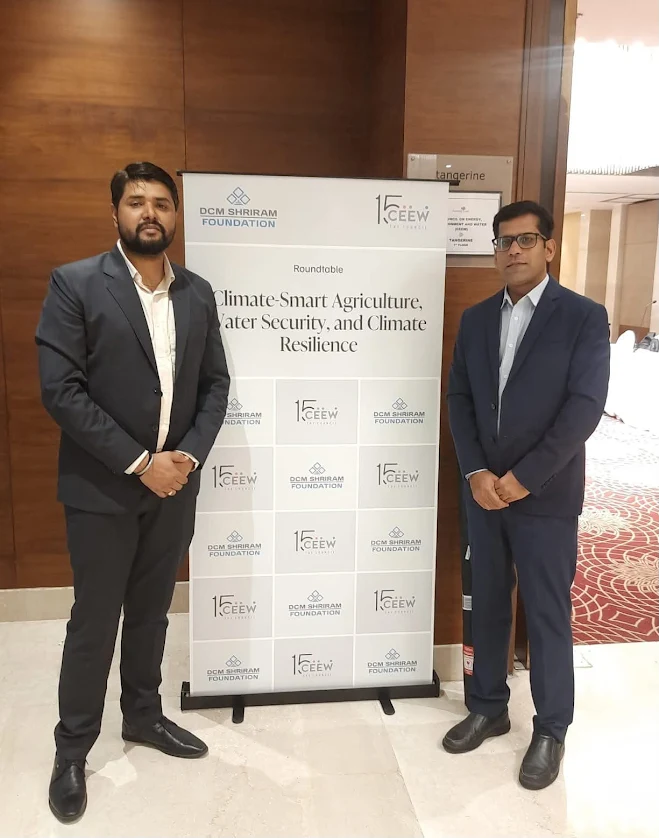
Sustainable Bharat Foundation was invited to participate in the roundtable on “climate- smart agriculture, water security and climate resilience in Uttar Pradesh”. We sincerely thank DCM SHRIRAM FOUNDATION and Council on Energy, Environment and Water (CEEW) for organizing this important roundtable.
Dr. Kumar reinforced 3 key priorities for scaling Climate-Smart Agriculture (CSA) which are also replicable over the other states of the Indo-Gangetic Plains:
✅ CSA must deliver livelihoods, not just sustainable practices. Climate-smart agriculture should be measured by its ability to enhance incomes and generate sustainable livelihoods—not only by improvements in soil health, reduced water consumption and productivity.
✅ Last-mile institutions are central to success. Platforms such as JEEViKA, SHGs, and FPOs are essential for knowledge transfer, collective action, and community-led adoption. Without leveraging these linkages, CSA will remain limited to pilots.
✅ CSA must be women-centric. Women are at the heart of agriculture and household resilience. Any CSA strategy that does not actively engage and empower women will not achieve real, lasting impact.
Quoting as an example, Dr. Kumar emphasized that the neighbouring state of Bihar demonstrates that strong last-mile institutions like JEEVIKA, Rural Development Department, Government of Bihar already exist. What is needed now is effective convergence around livelihoods, inclusion, and climate resilience.
SBF remains committed to advancing integrated, gender-responsive, and livelihood-focused climate action.