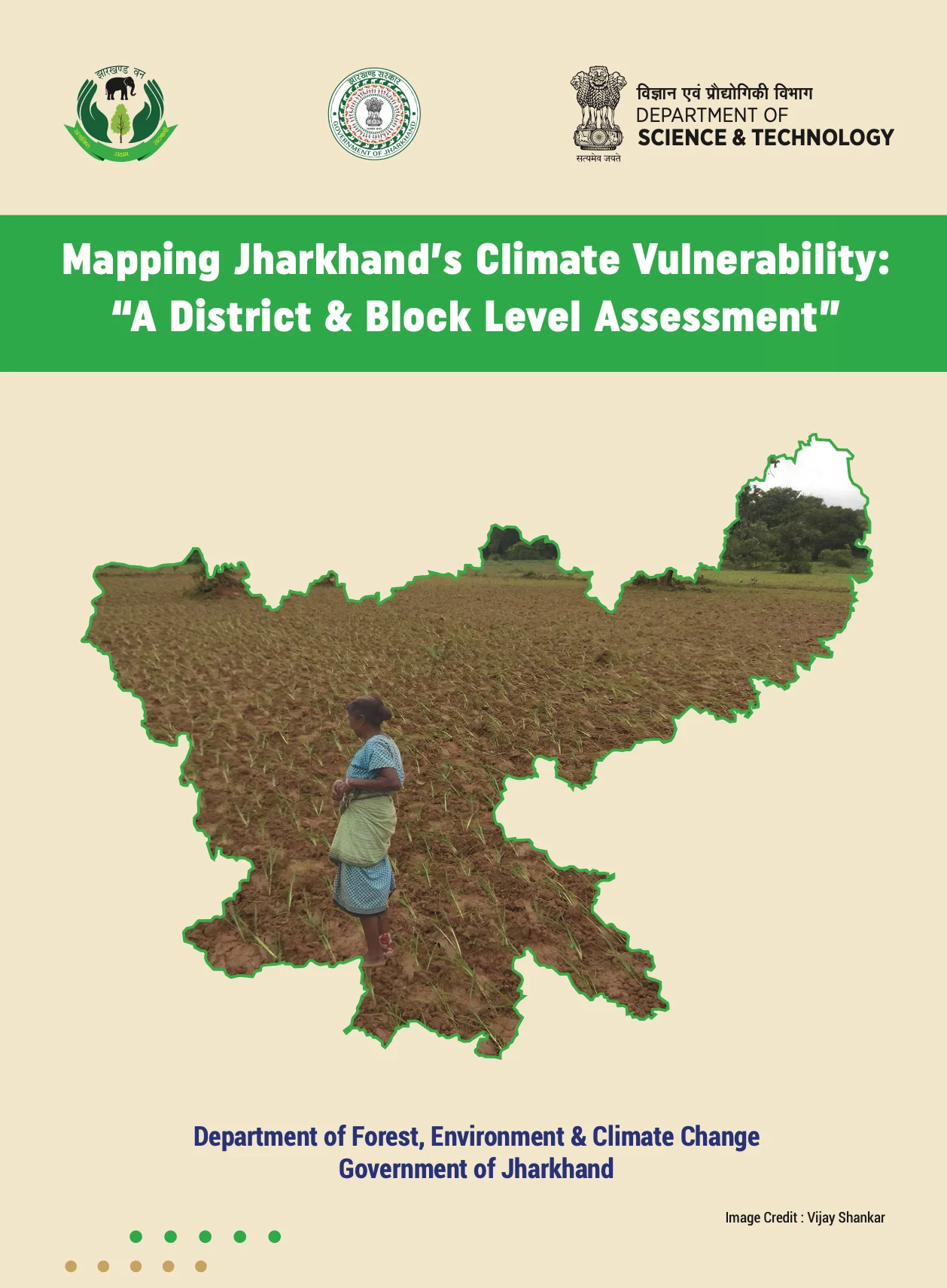
Climate change has become one of the most alarming global challenges for the 21st century. It refers to long term shifts in temperatures and weather patterns, primarily due to increased concentrations of GHG gases in the atmosphere. These changes are unprecedented in magnitude and speed, threatening ecosystems, economies and communities worldwide. Understanding climate change’s causes, future projections and consequences is crucial for developing effective climate mitigation and adaptation strategies. While the world is on a mission to reduce GHG emissions keeping its priority as economic development and trying to restrict the global temperature rise within 1.50C by the end of the 21st century. It is equally important to understand which sector of the economy and section of its population and society are more vulnerable to the impact of climate change events. The vulnerability level of each sector of the economy will vary across different regions depending on the geographical, socio-economic conditions and climate change impact. The impacts differ among the poor and marginalized women, men as well as children. Keeping in mind the micro-level adaptation planning and climate budgeting, this study has been commissioned by the State Forest Department of Jharkhand. This study consists of spatial and temporal forecasting (short-term, midterm and long-term) of the climatic variables like temperature and rainfall pattern and conducting in-depth climate vulnerability of Jharkhand state’s 14 most vulnerable districts (As per DST categorization). The spatial heat map generated by the climate model (GCM-CMPI6) shows that the expected rise in the temperature change is higher in the northeast and northern parts of the state. In this study, Copernicus’s climate model has been used for short-term, mid-term and long-term (2020-2100) climate change projections at the block level. On the trade-off between data and processing requirements and usefulness, the resolution of 2.5 minutes or ~20 sq. km (at the equator) has been chosen. This report presents climate projections and a block-level assessment of the climate vulnerability assessment of all six blocks of the Ramgarh district. This study is focused on conducting block- level climate vulnerability assessment and preparing a Composite Vulnerability Index (CVI) for all six blocks of the Ramgarh district. Vulnerability indices have been derived using twelve indicator categories which comes under into groups namely Socio-economic, Biophysical, Infrastructure and Health. Indicators are classified into adaptive capacity, sensitivity and exposure. Blocks are ranked based on the composite vulnerability indices and grouped into (1) Low (2) Moderate (3) High categories of vulnerability.
Mapping Jharkhand’s Climate Vulnerability: A District and Block-Level Assessment