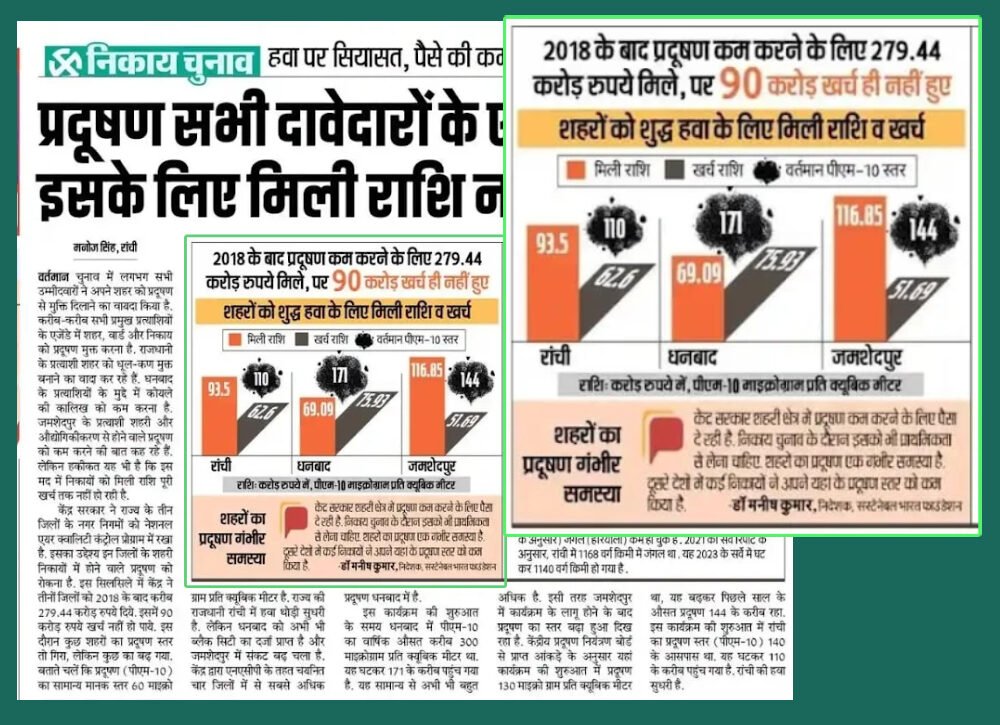
Clean air is fundamental to public health, economic productivity, and sustainable urban development. Yet, recent analysis highlighted in a report by senior journalist Manoj Singh from Prabhat Khabar, Ranchi reveals a critical governance challenge: while substantial financial resources have been allocated to improve air quality in Jharkhand’s cities, their utilization has not kept pace with the urgency of the problem.
Since 2018, Jharkhand’s major urban centers—including Ranchi, Dhanbad, and Jamshedpur—have received approximately ₹279.44 crore under the National Clean Air Programme (NCAP) and related initiatives. However, nearly ₹90 crore of this allocation remains unspent. This gap between fund allocation and utilization represents a missed opportunity to implement timely and targeted interventions that could significantly improve urban air quality.
Urban air pollution in Jharkhand continues to exceed national safety standards, particularly with respect to PM₁₀ concentrations. While financial support from the central government provides a strong foundation, meaningful improvements depend on how effectively these resources are translated into action on the ground.
Commenting on this issue, Dr. Manish Kumar, Executive Director of Sustainable Bharat Foundation, emphasized the need for prioritization and implementation at the city level:
“The central government is providing funds to reduce pollution in urban areas. This issue must also be prioritized during municipal elections. Urban pollution is a serious problem. Many cities in other countries have successfully reduced their pollution levels.”
Expanding on this, Dr. Kumar further noted:
“The data clearly indicate that fund allocation alone does not guarantee improvements in air quality. While the provision of funds under NCAP is an essential step, meaningful outcomes will depend on their timely, efficient, and strategic utilization, with direct focus on major emission sources. In cities such as Ranchi and Jamshedpur, priority must be given to controlling emissions from construction activities, vehicular sources, industrial operations, and open waste burning, which significantly contribute to PM₁₀ pollution. This requires scientifically robust source apportionment studies and hyperlocal action planning to accurately identify dominant pollution sources and implement targeted mitigation measures. Equally important is strengthening the technical capacity of Municipal Corporations to ensure effective planning, implementation, and monitoring, so that financial investments translate into measurable and sustained improvements in air quality.”
The situation highlights a broader structural issue: financial allocation must be complemented by institutional capacity, scientific planning, and effective governance. Municipal Corporations are at the forefront of implementing clean air interventions, yet many face limitations in technical expertise, project readiness, and monitoring capabilities.
To achieve sustained improvements, cities must adopt a science-driven and source-specific approach. Key emission sources—including construction activities, vehicular emissions, industrial operations, and open waste burning—must be systematically addressed through targeted and evidence-based interventions.
Scientific tools such as source apportionment studies and hyperlocal emission inventories can help identify dominant pollution sources and guide effective mitigation strategies. Strengthening technical capacity at the municipal level is equally critical to ensure that clean air action plans are implemented efficiently and deliver measurable results.
The availability of dedicated funding under NCAP provides a historic opportunity for Jharkhand to strengthen its urban environmental governance and improve air quality outcomes. With timely utilization of resources, robust scientific planning, and strengthened institutional capacity, cities can significantly reduce pollution levels and enhance the quality of life for millions of residents.
Global experience demonstrates that sustained political commitment, scientific planning, and accountable governance can deliver meaningful improvements in air quality. Jharkhand’s cities have the financial support and policy framework needed to achieve similar success.
At Sustainable Bharat Foundation, we are committed to supporting evidence-based policymaking, strengthening institutional capacity, and advancing sustainable urban transitions. Clean air is not only an environmental objective—it is essential to public health, economic resilience, and long-term sustainability.
Ensuring that allocated resources are strategically and effectively utilized will be critical to translating policy intent into real and lasting improvements in air quality. With coordinated action and scientific planning, Jharkhand can move decisively toward a cleaner, healthier, and more sustainable future.
Bridging the Gap Between Clean Air Funding and Clean Air Outcomes in Jharkhand